Orqelixar
Vertex Blueprint
Vertex Blueprint
Couldn't load pickup availability
- 📘 Digital file available after purchase
- ♾️ Long-term availability
- 🔒 Secure checkout
- 🗓️ Content updated in 2026
Self-paced learning overview
1. Problem Statement
After studying classes, inheritance, and interfaces, the next challenge is working with larger groups of objects and different data-processing scenarios. Fixed arrays are not always suitable when the number of elements can change or when information needs to be organized in different ways. Learners also need to understand situations where code execution does not follow the expected path. Dividing logic between classes becomes increasingly important so that each part of a program has a clear responsibility. Without this structure, even a learning project containing several entities can become difficult to read and modify.
2. Solution
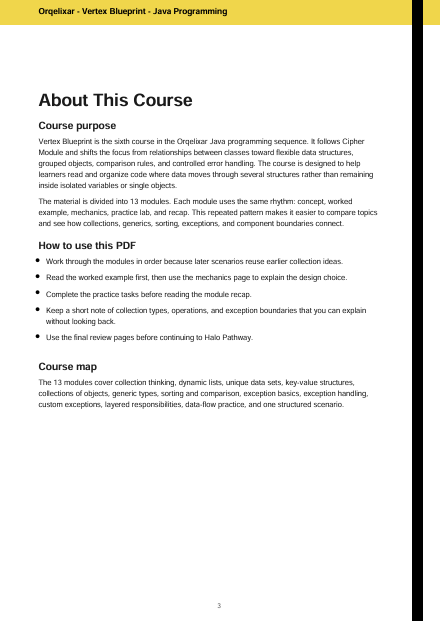
Vertex Blueprint introduces more flexible structures for storing and processing objects in Java. Learners examine several collection types and study how to choose a structure according to the nature of the data. Separate modules introduce generic types and ways to create code that works with different value types under defined rules. Exception handling explains how unexpected situations can be identified and processed during program execution. Final practice combines collections, classes, interfaces, and exception handling within a structured multi-component model.
3. What's Inside
- Module 1: Collection Thinking — move from fixed arrays toward structures where the number of elements can change during program execution.
- Module 2: Dynamic Lists — add, remove, search, and iterate through elements stored in sequential collections.
- Module 3: Unique Data Sets — work with structures that keep unique elements and compare this approach with ordinary lists.
- Module 4: Key and Value Structures — organize information as key-value pairs, retrieve data through keys, and update stored values.
- Module 5: Collections of Objects — store instances of custom classes inside collections, iterate through them, and call their methods.
- Module 6: Generic Types — explore generic types and create structures that can work with different data types within defined boundaries.
- Module 7: Sorting and Comparing — arrange objects according to selected characteristics and define comparison rules for learning models.
- Module 8: Exception Basics — examine exceptions, common reasons they occur, and situations where normal program flow is interrupted.
- Module 9: Handling Exceptions — catch exceptions, separate main logic from error-handling logic, and define clear responses to unexpected situations.
- Module 10: Custom Exceptions — create custom exception types for describing specific invalid situations within a learning model.
- Module 11: Layered Responsibilities — divide code between classes responsible for data storage, logic processing, and operation coordination.
- Module 12: Data Flow Practice — follow information as it moves between multiple classes, methods, and collections.
- Module 13: Structured Scenario — create a learning model where several object types are stored, examined, compared, and processed through separate logical components.
4. Who Is This For?
✅ This course may suit you if you:
- understand classes, objects, fields, and methods;
- have already worked with inheritance and interfaces;
- want to move from arrays to more flexible data structures;
- want to work with groups of objects;
- want to study exception handling;
- want to divide logic more clearly between several classes;
- are ready to work with learning models containing multiple connected components.
❌ This course may not suit you if you:
- are only beginning to study Java;
- have not yet worked with classes and objects;
- are unfamiliar with fundamental inheritance concepts;
- are looking only for material about basic syntax;
- do not plan to complete multi-class practical exercises.
5. What You'll Learn
- differences between arrays and dynamic collections;
- creating and using lists;
- adding and removing elements;
- searching for data within collections;
- working with unique groups of values;
- key-value structures;
- storing custom objects in collections;
- iterating through and filtering groups of objects;
- fundamentals of generic types;
- sorting learning data sets;
- defining comparison rules;
- the concept of exceptions;
- catching and handling exceptions;
- creating custom exception types;
- dividing responsibilities between classes;
- organizing data flow between components;
- reading code containing several connected structures;
- building a multi-component learning model.
6. Refund Policy
Vertex Blueprint includes a 30-day refund policy according to the refund terms stated on the Orqelixar website.
7. Certificates & Credentials
After completing Vertex Blueprint, the learner receives an Orqelixar certificate confirming completion of this course.
Do I need previous Java experience?
Do I need previous Java experience?
Not for every course. The introductory courses cover the basic principles of Java, while later tiers gradually introduce more detailed topics and build on knowledge covered in earlier levels.
Can I study at my own pace?
Can I study at my own pace?
Yes. The materials can be studied according to your own schedule, allowing you to revisit earlier topics and repeat examples whenever additional review is useful.
How do the Orqelixar tiers differ?
How do the Orqelixar tiers differ?
The tiers increase in material volume and technical depth. Introductory courses focus on the basic structure of Java, while later courses add objects, collections, data handling, code organization, and more detailed practical assignments.
Share