Orqelixar
Slate Guide
Slate Guide
Couldn't load pickup availability
- 📘 Digital file available after purchase
- ♾️ Long-term availability
- 🔒 Secure checkout
- 🗓️ Content updated in 2026
Self-paced learning overview
1. Problem Statement
After working with arrays, loops, and methods, code gradually begins to contain more data and connected operations. Keeping all information in separate variables becomes inconvenient, particularly when several values describe one entity. Learners need to understand how related data and behavior can be grouped into one logical structure. Classes, objects, fields, constructors, and interaction between instances introduce a different way of organizing code. Without a clear sequence, these concepts can appear to be separate rules rather than connected parts of one model.
2. Solution
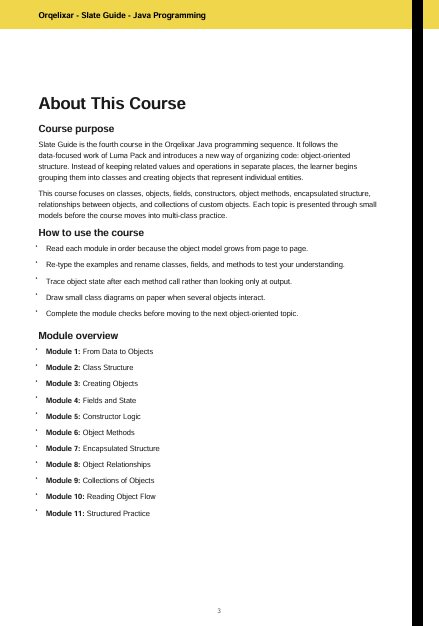
Slate Guide explains object structure through small models that gradually expand throughout the course. Learners first examine the difference between a class and an object created from that class. Fields, constructors, and methods are then introduced to describe object state and behavior. Later modules demonstrate how several objects can exchange data and use functionality provided by other structures. Practical work helps organize code around understandable entities instead of large groups of unrelated variables and instructions.
3. What's Inside
- Module 1: From Data to Objects — move from individual variables and arrays toward objects that combine related data and operations.
- Module 2: Class Structure — examine class structure, its main components, and ways to describe a custom entity in Java.
- Module 3: Creating Objects — create class instances, store them in variables, and work with several objects of the same type.
- Module 4: Fields and State — work with fields, store object characteristics, and modify object state during program execution.
- Module 5: Constructor Logic — create constructors, provide initial values, and prepare new objects for later operations.
- Module 6: Object Methods — create methods inside classes and use them to work with data belonging to a particular object.
- Module 7: Encapsulated Structure — organize fields and methods so responsibility for working with data remains within the relevant structure.
- Module 8: Object Relationships — model simple connections between objects and pass one object into methods belonging to another.
- Module 9: Collections of Objects — store multiple objects, iterate through their values, and perform operations across groups of entities.
- Module 10: Reading Object Flow — examine object creation order, method calls, and changes in data during program execution.
- Module 11: Structured Practice — create a small learning model containing several classes, objects, fields, constructors, and methods.
4. Who Is This For?
✅ This course may suit you if you:
- have already worked with variables, conditions, and loops;
- understand how basic methods are created;
- are familiar with arrays and fundamental data processing;
- want to begin working with classes and objects;
- want to organize related data more clearly;
- want to understand how separate parts of a program interact;
- are ready to build small models containing several classes.
❌ This course may not suit you if you:
- have not yet worked with fundamental Java syntax;
- are unfamiliar with methods and parameter passing;
- are looking only for an introductory overview of programming;
- already work extensively with complex architecture and large object-oriented systems.
5. What You'll Learn
- the difference between a class and an object;
- creating custom classes;
- creating several instances of one class;
- defining and using fields;
- modifying object state;
- creating constructors;
- providing initial data through constructors;
- creating methods within classes;
- using fields inside methods;
- passing objects as parameters;
- organizing fundamental relationships between objects;
- working with groups of objects;
- dividing responsibilities between classes;
- reading code containing several interacting objects;
- following changes in program state;
- creating a small multi-class learning model.
6. Refund Policy
Slate Guide includes a 30-day refund policy according to the refund terms stated on the Orqelixar website.
7. Certificates & Credentials
After completing Slate Guide, the learner receives an Orqelixar certificate confirming completion of this course.
Do I need previous Java experience?
Do I need previous Java experience?
Not for every course. The introductory courses cover the basic principles of Java, while later tiers gradually introduce more detailed topics and build on knowledge covered in earlier levels.
Can I study at my own pace?
Can I study at my own pace?
Yes. The materials can be studied according to your own schedule, allowing you to revisit earlier topics and repeat examples whenever additional review is useful.
How do the Orqelixar tiers differ?
How do the Orqelixar tiers differ?
The tiers increase in material volume and technical depth. Introductory courses focus on the basic structure of Java, while later courses add objects, collections, data handling, code organization, and more detailed practical assignments.
Share