Orqelixar
Luma Pack
Luma Pack
Couldn't load pickup availability
- 📘 Digital file available after purchase
- ♾️ Long-term availability
- 🔒 Secure checkout
- 🗓️ Content updated in 2026
Self-paced learning overview
1. Problem Statement
After studying conditions, loops, and basic methods, learners need to work with groups of values rather than only individual pieces of data. This requires understanding how several values can be stored, reviewed, and processed through repeated operations. Working with text also introduces additional rules and approaches to data handling. When every operation remains inside one large block of code, learning examples gradually become more difficult to read and modify. The next stage therefore involves combining data structures, loops, and methods in a more organized form.
2. Solution
Luma Pack introduces fundamental ways to store and process groups of values in Java. Learners move from creating arrays to reading, modifying, searching, and comparing their elements. Separate modules focus on strings and common operations involving textual data. Methods are used to divide data-processing tasks into smaller logical sections. The final part of the course combines several topics in practical exercises where learners determine an appropriate sequence of operations.
3. What's Inside
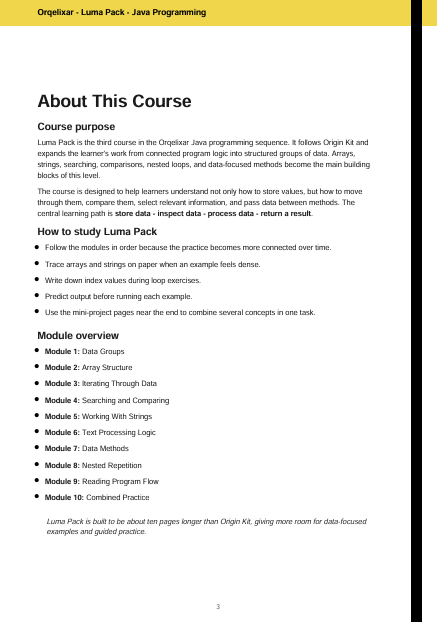
- Module 1: Data Groups — explore groups of data, the purpose of arrays, and the difference between an individual value and a collection of values.
- Module 2: Array Structure — create arrays, work with indexes, retrieve elements, modify values, and determine array length.
- Module 3: Iterating Through Data — use loops to review elements sequentially and perform repeated operations.
- Module 4: Searching and Comparing — search for values, compare elements, count matches, and examine predefined conditions.
- Module 5: Working With Strings — create and compare strings, retrieve parts of text, and perform fundamental character operations.
- Module 6: Text Processing Logic — examine textual values, locate fragments, modify strings, and combine text processing with conditional logic.
- Module 7: Data Methods — pass arrays and textual values into methods, return results, and divide operations into separate code sections.
- Module 8: Nested Repetition — work with nested loops in tasks that require several levels of repeated operations.
- Module 9: Reading Program Flow — examine execution order, follow changing values, and identify issues in program logic.
- Module 10: Combined Practice — complete learning tasks that combine arrays, strings, conditions, loops, and methods within one scenario.
4. Who Is This For?
✅ This course may suit you if you:
- understand variables, data types, and common operators;
- are familiar with conditional structures;
- understand the basic principles of loops;
- have already created simple methods;
- want to work with groups of values;
- want more practice processing textual and numerical data;
- are ready to examine code containing several connected parts.
❌ This course may not suit you if you:
- have not yet studied fundamental Java syntax;
- have not worked with conditions and loops;
- are looking only for a short introduction to the language;
- already work extensively with complex data structures and large object models.
5. What You'll Learn
- creating and using arrays;
- working with indexes;
- reading and modifying array elements;
- iterating through groups of data with loops;
- locating values according to defined conditions;
- counting and comparing elements;
- working with textual values;
- fundamental string operations;
- examining individual characters and parts of text;
- passing data into methods;
- returning processed values from methods;
- using nested loops;
- separating data operations into logical sections;
- following value changes during program execution;
- identifying fundamental logical errors;
- combining several Java structures within one practical task.
6. Refund Policy
Luma Pack includes a 30-day refund policy according to the refund terms stated on the Orqelixar website.
7. Certificates & Credentials
After completing Luma Pack, the learner receives an Orqelixar certificate confirming completion of this course.
Do I need previous Java experience?
Do I need previous Java experience?
Not for every course. The introductory courses cover the basic principles of Java, while later tiers gradually introduce more detailed topics and build on knowledge covered in earlier levels.
Can I study at my own pace?
Can I study at my own pace?
Yes. The materials can be studied according to your own schedule, allowing you to revisit earlier topics and repeat examples whenever additional review is useful.
How do the Orqelixar tiers differ?
How do the Orqelixar tiers differ?
The tiers increase in material volume and technical depth. Introductory courses focus on the basic structure of Java, while later courses add objects, collections, data handling, code organization, and more detailed practical assignments.
Share