Orqelixar
Halo Pathway
Halo Pathway
Couldn't load pickup availability
- 📘 Digital file available after purchase
- ♾️ Long-term availability
- 🔒 Secure checkout
- 🗓️ Content updated in 2026
Self-paced learning overview
1. Problem Statement
After studying collections, generic types, and exceptions, learners can already create detailed learning models, but increasing the number of classes introduces another challenge. Data may travel through several components while storage, validation, and processing logic begin to overlap within the same structures. Programs therefore require clearer separation between parts with different responsibilities. Additional complexity can arise when processing collections, reading external data, and passing results between methods. At this stage, it becomes useful to understand not only individual classes but also the complete route data follows through a program.
2. Solution
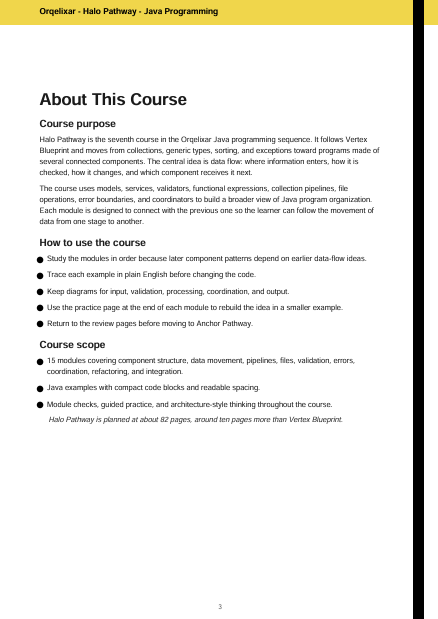
Halo Pathway demonstrates how Java code can be organized into several logically separated components. Learners examine models where classes handle data, processing rules, and coordination of individual operations. The course introduces functional approaches to collection processing and ways to organize repeated data operations more clearly. Separate modules cover reading and writing data and examining how information moves between parts of a program. Final practice combines these topics in a multi-component learning scenario with clearly divided roles.
3. What's Inside
- Module 1: Component Structure — examine a program as a group of connected parts and identify the role of each component.
- Module 2: Responsibility Layers — separate logic between structures responsible for storing data, processing information, and coordinating operations.
- Module 3: Data Transfer — pass objects and values between methods and classes while reducing unnecessary duplication.
- Module 4: Functional Expressions — explore concise functional constructs for describing operations performed on data.
- Module 5: Collection Pipelines — filter, modify, and process collection elements through connected sequences of operations.
- Module 6: Data Filtering — define conditions for selecting relevant objects from larger data groups.
- Module 7: Mapping Values — convert objects and values into new forms according to the requirements of a task.
- Module 8: Aggregation Logic — count, group, and derive summarized values from collections of data.
- Module 9: File Reading — read textual information, divide incoming data into parts, and prepare it for further processing.
- Module 10: File Writing — create structured results and write data to files within learning scenarios.
- Module 11: Validation Flow — examine incoming values before passing them to later program components.
- Module 12: Error Boundaries — place exception handling in appropriate parts of a program and separate it from primary logic.
- Module 13: Coordinating Components — create classes that manage sequences of operations across several structures.
- Module 14: Refactoring Practice — reorganize a large block of code into smaller components with clearer responsibilities.
- Module 15: Integrated Scenario — build a learning system that receives data, validates it, processes collections, and transfers results between separate components.
4. Who Is This For?
✅ This course may suit you if you:
- understand classes, objects, and interfaces;
- have already worked with collections;
- are familiar with generic types;
- understand fundamental exception handling;
- want to organize programs containing many classes more clearly;
- want to explore collection-processing flows;
- want to separate data storage from program logic;
- are ready to work with broader learning scenarios.
❌ This course may not suit you if you:
- are only beginning to study Java;
- have not yet created custom classes;
- have not worked with collections;
- are looking only for material about basic syntax;
- do not plan to work with several interacting components.
5. What You'll Learn
- dividing programs into logical components;
- distributing responsibilities between classes;
- passing data between different parts of a program;
- working with functional constructs;
- processing collections through connected operations;
- filtering groups of objects;
- mapping and converting values;
- grouping and counting data;
- creating collection-processing pipelines;
- reading textual data from files;
- writing structured results;
- validating incoming values;
- organizing exception handling;
- coordinating several classes;
- examining data flow through a program;
- reorganizing large code sections;
- building a multi-component learning model.
6. Refund Policy
Halo Pathway includes a 30-day refund policy according to the refund terms stated on the Orqelixar website.
7. Certificates & Credentials
After completing Halo Pathway, the learner receives an Orqelixar certificate confirming completion of this course.
Do I need previous Java experience?
Do I need previous Java experience?
Not for every course. The introductory courses cover the basic principles of Java, while later tiers gradually introduce more detailed topics and build on knowledge covered in earlier levels.
Can I study at my own pace?
Can I study at my own pace?
Yes. The materials can be studied according to your own schedule, allowing you to revisit earlier topics and repeat examples whenever additional review is useful.
How do the Orqelixar tiers differ?
How do the Orqelixar tiers differ?
The tiers increase in material volume and technical depth. Introductory courses focus on the basic structure of Java, while later courses add objects, collections, data handling, code organization, and more detailed practical assignments.
Share