Orqelixar
Cipher Module
Cipher Module
Couldn't load pickup availability
- 📘 Digital file available after purchase
- ♾️ Long-term availability
- 🔒 Secure checkout
- 🗓️ Content updated in 2026
Self-paced learning overview
1. Problem Statement
After studying classes and objects, learners can describe individual entities, but later tasks require more flexible structures. Several classes may share similar properties or behavior, and repeating the same code can gradually make a program harder to maintain. Learners need to understand how common characteristics can be placed into shared structures and reused by related classes. Another important topic is defining common rules for interaction between different object types. Without a structured approach, relationships between classes can become unclear even in a relatively small learning project.
2. Solution
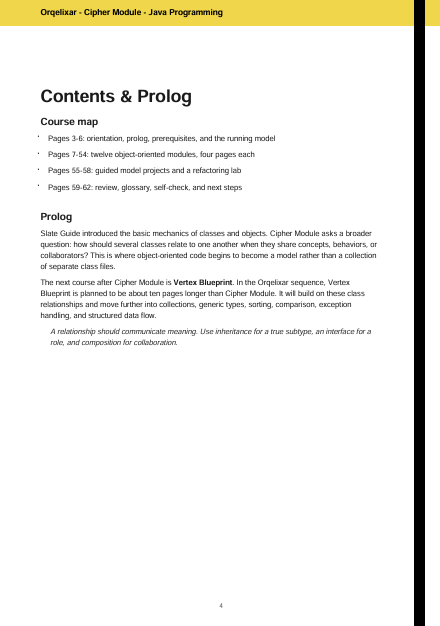
Cipher Module explains ways to organize related classes through sequential examples and practical models. Learners examine how shared fields and methods can be placed in base structures and used by derived classes. The course then demonstrates how inherited behavior can be changed without repeating the complete logic. Abstract structures and interfaces are introduced as ways to describe shared rules for different types of objects. Final modules combine these ideas within a multi-class model where responsibilities are divided clearly.
3. What's Inside
- Module 1: Class Connections — review interaction between classes and examine how data and behavior can be distributed across several structures.
- Module 2: Inheritance Structure — study inheritance, create base and derived classes, and share common characteristics between related structures.
- Module 3: Shared Behavior — organize methods used by several related classes and reduce repeated logic.
- Module 4: Method Overriding — modify inherited method behavior and create different implementations for individual object types.
- Module 5: Polymorphic Logic — work with different object types through a common structure and examine how appropriate behavior is selected during program execution.
- Module 6: Abstract Structures — use abstract classes to describe shared logic without creating complete objects from the base type.
- Module 7: Interface Concepts — create interfaces, define shared behavior rules, and implement them in different classes.
- Module 8: Multiple Roles — build classes that can perform several defined roles through separate interfaces.
- Module 9: Composition Basics — create structures where one object contains or works with other objects instead of relying directly on inheritance.
- Module 10: Choosing Relationships — compare inheritance and composition through small examples and select structures according to learning-task logic.
- Module 11: Model Organization — divide responsibilities between classes and build a clear interaction structure between objects.
- Module 12: Multi-Class Practice — create a learning model combining base classes, derived structures, interfaces, methods, and composition.
4. Who Is This For?
✅ This course may suit you if you:
- have already created custom classes and objects;
- understand fields, methods, and constructors;
- have worked with several connected classes;
- want to explore inheritance in greater detail;
- want to understand the role of abstract structures and interfaces;
- want to distribute behavior across different object types;
- are ready to work with multi-class learning models.
❌ This course may not suit you if you:
- have not yet studied classes and objects;
- are unfamiliar with constructors and methods;
- are only beginning to study Java;
- are looking for materials without practical coding exercises.
5. What You'll Learn
- building relationships between classes;
- creating base and derived classes;
- reusing shared behavior;
- overriding methods;
- working with different object types through a common structure;
- understanding polymorphic behavior;
- creating abstract classes;
- defining abstract methods;
- creating and implementing interfaces;
- organizing multiple roles within one class;
- using composition;
- choosing between inheritance and composition;
- distributing responsibilities between classes;
- reading multi-class code;
- examining object interaction;
- creating a structured learning model with several entity types.
6. Refund Policy
Cipher Module includes a 30-day refund policy according to the refund terms stated on the Orqelixar website.
7. Certificates & Credentials
After completing Cipher Module, the learner receives an Orqelixar certificate confirming completion of this course.
Do I need previous Java experience?
Do I need previous Java experience?
Not for every course. The introductory courses cover the basic principles of Java, while later tiers gradually introduce more detailed topics and build on knowledge covered in earlier levels.
Can I study at my own pace?
Can I study at my own pace?
Yes. The materials can be studied according to your own schedule, allowing you to revisit earlier topics and repeat examples whenever additional review is useful.
How do the Orqelixar tiers differ?
How do the Orqelixar tiers differ?
The tiers increase in material volume and technical depth. Introductory courses focus on the basic structure of Java, while later courses add objects, collections, data handling, code organization, and more detailed practical assignments.
Share