Orqelixar
Anchor Pathway
Anchor Pathway
Couldn't load pickup availability
- 📘 Digital file available after purchase
- ♾️ Long-term availability
- 🔒 Secure checkout
- 🗓️ Content updated in 2026
Self-paced learning overview
1. Problem Statement
When a program contains many classes, transferring information between them requires a clearly defined structure. Data may enter in one form, go through validation, change during processing, and then move to another part of the program. When individual classes handle too many unrelated responsibilities, the logic gradually becomes harder to read and modify. Additional attention is needed when several operations depend on one another or follow different execution sequences. At this stage, it is useful to view a program as a system of data flows and clearly separated responsibilities.
2. Solution
Anchor Pathway organizes study around the complete journey of data from input to final processing. Learners work with separate models, service classes, validation logic, and components responsible for coordinating operations. The course demonstrates how data can be converted between structures without placing unrelated logic inside one large class. Separate modules introduce sequential and parallel task execution along with the coordination of shared resources. Final practice combines these topics within a structured model containing several data flows and clearly defined boundaries between components.
3. What's Inside
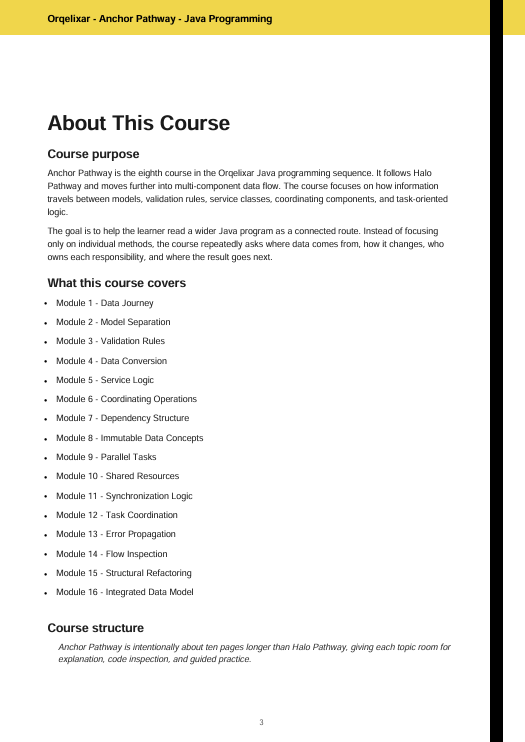
- Module 1: Data Journey — examine the complete route of data from its initial form through validation, processing, and final transfer.
- Module 2: Model Separation — create separate structures representing data at different stages of program execution.
- Module 3: Validation Rules — define checks for numerical, textual, and object values before further processing.
- Module 4: Data Conversion — convert one learning model into another and transfer selected values between structures.
- Module 5: Service Logic — organize classes responsible for processing information and carrying out defined operations.
- Module 6: Coordinating Operations — create components that determine the sequence of calls between models and service classes.
- Module 7: Dependency Structure — examine relationships between classes and ways to provide required components without unnecessary coupling.
- Module 8: Immutable Data Concepts — explore structures whose state remains unchanged after creation and situations where this approach can simplify data handling.
- Module 9: Parallel Tasks — introduce the basic idea of running several independent operations within one learning scenario.
- Module 10: Shared Resources — examine situations where several parts of a program work with the same data.
- Module 11: Synchronization Logic — study principles for coordinating operations that interact with a shared resource or depend on one another.
- Module 12: Task Coordination — create sequences where a later operation depends on completion of an earlier one.
- Module 13: Error Propagation — transfer information about errors between layers and select an appropriate component for handling them.
- Module 14: Flow Inspection — follow values, method calls, and state changes across several program components.
- Module 15: Structural Refactoring — redistribute logic between classes, reduce unnecessary dependencies, and clarify component responsibilities.
- Module 16: Integrated Data Model — build a learning system where data moves through validation, conversion, processing, and several interacting components.
4. Who Is This For?
✅ This course may suit you if you:
- have worked with multi-class Java models;
- understand collections, generic types, and exception handling;
- are familiar with functional collection processing;
- want to understand data movement between components in greater detail;
- want to separate models, validation, and processing logic;
- want to explore fundamental concepts of parallel execution;
- are ready to examine dependencies between many classes;
- want to work with broader learning structures.
❌ This course may not suit you if you:
- are only beginning to study Java;
- have not yet worked with classes and collections;
- are unfamiliar with exceptions;
- are looking only for syntax-focused material;
- do not plan to work with programs containing many interacting components.
5. What You'll Learn
- examining complete data routes through a program;
- creating separate models for different processing stages;
- defining data-validation rules;
- converting between models;
- organizing service logic;
- coordinating several operations;
- examining dependencies between classes;
- working with structures whose state remains unchanged;
- fundamentals of running multiple tasks;
- working with shared resources;
- basic coordination of parallel operations;
- creating dependent task sequences;
- transferring error information between components;
- examining execution flow;
- tracking changes in data;
- reorganizing multi-class code;
- distributing responsibilities between components;
- building an integrated learning model with several processing flows.
6. Refund Policy
Anchor Pathway includes a 30-day refund policy according to the refund terms stated on the Orqelixar website.
7. Certificates & Credentials
After completing Anchor Pathway, the learner receives an Orqelixar certificate confirming completion of this course.
Do I need previous Java experience?
Do I need previous Java experience?
Not for every course. The introductory courses cover the basic principles of Java, while later tiers gradually introduce more detailed topics and build on knowledge covered in earlier levels.
Can I study at my own pace?
Can I study at my own pace?
Yes. The materials can be studied according to your own schedule, allowing you to revisit earlier topics and repeat examples whenever additional review is useful.
How do the Orqelixar tiers differ?
How do the Orqelixar tiers differ?
The tiers increase in material volume and technical depth. Introductory courses focus on the basic structure of Java, while later courses add objects, collections, data handling, code organization, and more detailed practical assignments.
Share